
The Final Four is Fixed
Packaging amateur sports for maximum profitability


The labor conditions for today’s collegiate athlete in revenue-oriented sports are substantially improved from what they were, merely a decade ago. Name-Image-Likeness (NIL) licensing and annual free agency have collapsed some of the most exploitive practices of the past. While the new system is an improvement, there remains an underlying relation of production designed to generate recreational opportunities for student-athletes, based principally on the labors of athlete-students; those whose primary motivation for attending college is to prepare for a potential career playing their sport professionally.
Football started as a collegiate game, so the professional leagues that later came about had a minor league built-in. While basketball was invented at a YMCA, the game spread to college campuses before the NBA was formed, so that league also saw no need to expend on young player development. Both the NFL and NBA have been content to let the NCAA develop their corps of players. The globalization of basketball led the NBA to sponsor its own developmental league, principally for foreign players, and Americans not academically-qualified for the NCAA.
The NCAA’s traditional revenue-generating sports through the 1990’s were football and men’s basketball. Women’s basketball has since also become a revenue-generator beyond a niche of teams, with their own commercialized Final Four tournament.
The NCAA runs national championship tournaments in many of the sports it offers, in all divisions of competition, though only the Division I basketball tournaments and the recently-created football championship tournament have captured national attention, and billion-dollar broadcasting (or streaming) contracts.
Player free agency is disrupting the powerhouse program landscape in the revenue sports. The University of Indiana, long a formidable presence in the Final Four men’s basketball tournament, won the national football championship this past season. It was the first time an Indiana football team ended a season ranked in the top 20. Meanwhile football programs at SEC schools such as perennial top-5 Alabama and Georgia are having to adjust for crumbling legacies; ones that had made the very top high school prospects in the nation seek to play for them.
We are seeing more upsets in recent basketball tournaments, but the tournament remains designed to reward high-ranked teams, rather than through fair competition.
Maximizing Commercial Appeal
The NCAA basketball tournament is divided into four Geographic Regional tournaments that lead to the Final Four. The geographical regions are designated (more or less) by where the games will be played, relative to the other three locations: in recent years, East, South, Midwest, West.
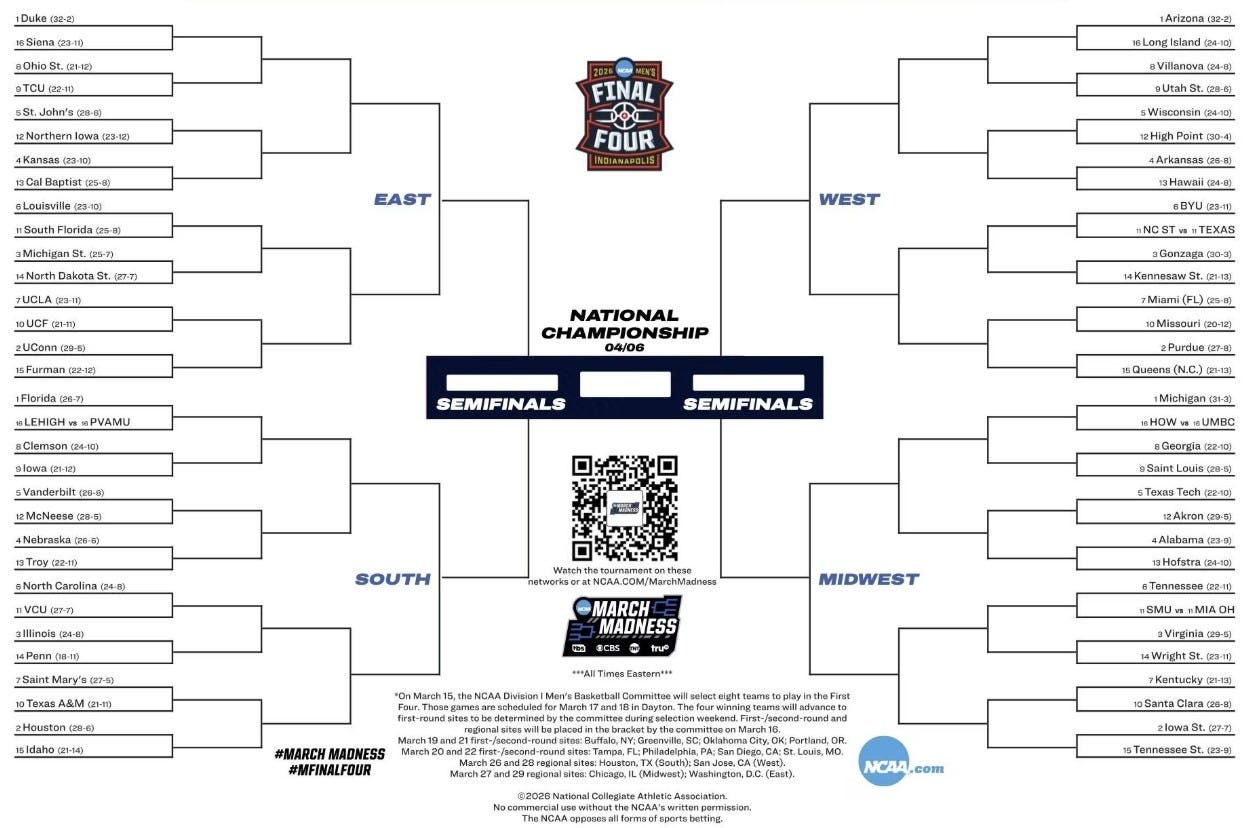

Teams, however, are not necessarily assigned by region. Here is the 2026 West Regional bracket:
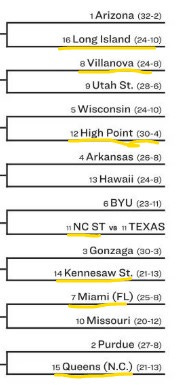
Six (perhaps seven, NC State and Texas have a play-in) of the 16 teams are from states on the Eastern seaboard: New York, Pennsylvania, North Carolina, Georgia, and Florida.
Here is the 2026 East Regional bracket:
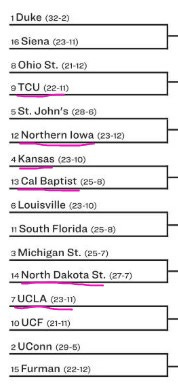
Six of the 16 teams in the East Regional are from states west of the Mississippi River. Ohio State, Louisville, and Michigan State, while situated east of the Mississippi, would seem to have a better geographic fit in the Midwest Regional.
Regional tournaments are put together by a committee that seeks to create Final Four matchups of the top-ranked teams in the nation. The Division I team that has the best regular-season record (this year, both Duke and Arizona have 32-2 records) will almost assuredly secure a #1 seed, and if not, then they will be no lower than #2. If one’s team does not have the best regular-season record, but it has a large national following, like Kentucky (with a 21-13 regular season record—tied for most losses among tournament-qualifiers, ranked #7 in the Midwest Regional) that will also increase a team’s placement in the rankings.
Why would popularity affect a team’s ranking? Audience draw provides the broadcaster value, and the Final Four tournament needs to be made worth its price. Placing a loss-leading Kentucky team in a regional increases the anticipated viewership; ranking them in the top half of their regional tournament increases the likelihood they will play more than once.
Because placing any team in the top half of a regional conference, while faithfully ranking all other teams, offers those top-ranked teams the easiest expected path to win. Not only does the NCAA rank teams prior to the tournament, they also structure the tournament to make it easiest for the top teams to qualify for the Final Four.
Place Your Bets
If you plan to wager on the Final Four, always pick the #1’s—the tournament is designed in their favor. Upsets happen in the middle rankings every year, but a #15 has defeated a #2 only one time ever, and a #1 has never lost to a #16. The talent gap between a Big 10 team made up of athlete-students and a team of student-athletes who earned a tournament slot by winning the Patriot League (Lehigh gets a play-in game) is on display every year, in the first round of the Final Four tourney.
The #1-ranked team in a regional tournament plays the #16 team, which in recent years has had to win a play-in while the #1 team got to rest. #1 always beats #16. They then face the winner of the #8/#9 game. Of the 32 teams remaining in the tournament after Day 1, the #8 team in a regional would be somewhere around the 30th-best team in the nation, facing one of the top four. The #1 team is not only facing a team outside the Top 25, they also likely had a much easier time defeating their prior opponent and should be less prone to fatigue.
Should the #1 team prevail in their second round game, they will advance to the Regional Semifinals, “The Sweet Sixteen,” where the highest-ranked team they could face in that round would be #4, and could potentially be as low as #13. Winning that game, the #1 ranked team in the regional may eventually have to play #2, but if they do, it is guaranteed not to be until the Regional Finals.
A #1-ranked team will not face another overall Top-8 team, until their fourth tournament game, at the earliest. It is no wonder the Final Four is overpopulated with Regional #1’s. It takes six consecutive wins, to win the tournament, but for the top-ranked teams only the Regional Finals game, and the game(s) of the Final Four should be competitive challenges.
Random Assignments Would Work Just as Well for Competition’s Sake
But if a basketball team is deserving of being named National Champion, then it should be able to win the tournament, no matter where it is ranked or who it has to play. Rather than laying out the cushiest path possible for a pre-Chosen Four, the NCAA could assign teams by actual geography to the regional tournaments, and then use a random number generator to create the initial brackets.
It would mean the winningest teams of the previous season may end up playing each other in the first or second round—what would be a Regional Final or Final Four game, under the old method. It would still draw, though it would be impossible to schedule the game for the maximum live TV audience, as they do for the Regional Finals and all Final Four (actually, there are just 3) games.
For years, the NCAA insisted its athletes be maximally exploited, and they were not permitted to receive any compensation related to their sport. They claimed it was in the name of protecting amateurism, but even then, the NCAA was fixing their basketball tournament to maximize commercial appeal.