
Two Markets, One Message
Consumer advocates must also account for labor

To what degree should CONSUMER ADVOCATES be publicly concerned about where consumers obtain their supply of a quasi-legal substance?

One of the most pressing issues to NORML at the moment is the organization’s relationship with the newly-legal cannabis industry found in 23 of the 50 states, while there is an ongoing federal criminal prohibition of any amount of “marijuana.”
Cultivators, manufacturers, and retailers share limited interests with cannabis consumers. Consumers seek their products, and their purchases fund business operations. However, aside from a common interest in cannabis, the buyer and the seller are in opposition to each other. Buyers seek the greatest return of product or service for their money, and sellers see the greatest return of money for their product or service. Each has an interest built in, to take advantage of the other.
This is merely the second phase of capitalist production. The first phase is in the manufacture of the commodity, where the future-seller is purchasing raw materials and labor-power at the lowest possible price and converting this to products. When the manufacturer is the buyer, the buyer holds the same interest vis-a-vis those they would buy from. Again, seeking to take the greatest advantage possible—the lowest costs (lowest pay) translates to a greater potential return on Exchange Value when the commodity is sold.
A Rate of Exploitation is calculated by adding the costs of Raw Materials and Labor-Power to get an Absolute Value of a commodity. The Absolute Value is subtracted from the Exchange Value realized when a commodity is sold, to find the Surplus Value. The ratio between the cost of Labor-Power to produce a commodity and the Surplus Value returned with its sale is the Rate of Exploitation. See the following for more on the Rate of Exploitation:

Both at the point of production and at the point of purchase, the worker-consumer is in a contentious relationship where the employer-seller is first seeking to suppress wages and then seeking to maximize sales revenues. For everyday consumables such as food or drugs, the worker-consumer is very often the same person, but regardless, the worker-consumer is always of the same social class relative to those who purchase labor-power and sell commodities.
This is why organizations that seek to represent consumers ALSO have to represent workers in the industry that produces the goods they consume.
Standing in only one phase of capitalist production—consumption—without taking into account the means by which consumers are enabled to consume—production—will result in odd advocacies.
Taxes commensurate with the social costs of consumption are a means of adjusting for the human inclination toward, for lack of a better term, “sin.” Consumption taxes on non-necessities are voluntary taxes, assumed only by those who choose to consume. Taxation beyond social costs is a form of prohibition; the first marihuana prohibition was a federal tax of $100 per ounce.
There is evidence from tobacco trafficking that consumers will evade high taxes. I once encountered a New Hampshire-based operation that purchased volumes of that state’s low-tax tobacco (NH had the second-lowest cigarette taxes in the nation at the time, greater than only Virginia’s) and made regular runs to NYC, where they received 150% or more of the NH retail cost per carton.
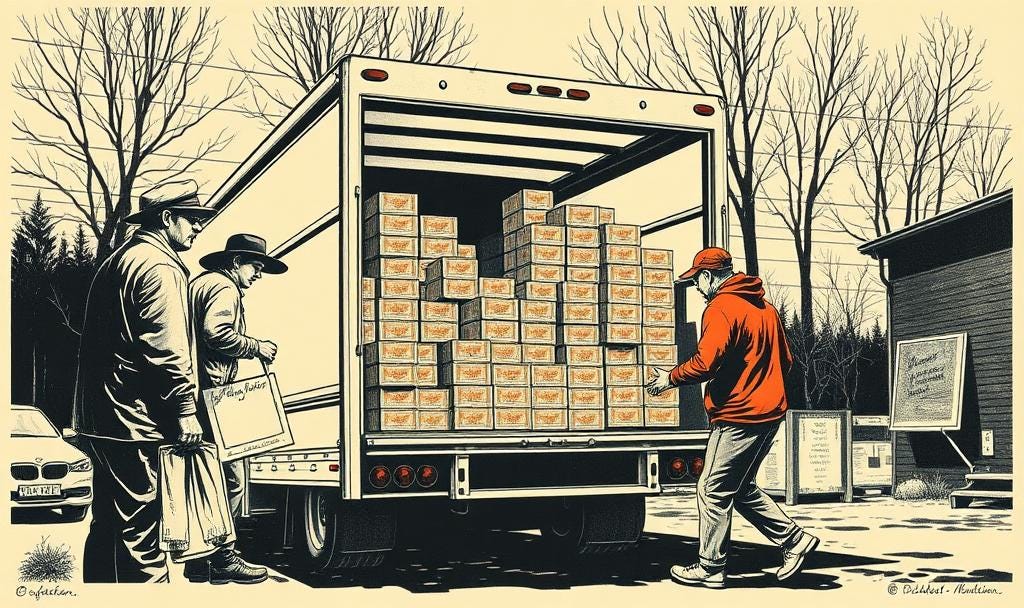
California is bordered by Oregon, Nevada, Arizona, and Mexico—all of which have legal cannabis markets and potentially-lower tax rates. Raising California’s retail cannabis tax might result in out-migration of tax revenues, should the difference in price approach the 1.5:1 ratio that made interstate tobacco smuggling a viable enterprise in New Hampshire.
It is in the licensed California cannabis industry’s interest to keep taxes low enough to compete with border states. So that a consumer who lives a short distance from the state line will stay “home,” rather than cross for a significantly-lower price for a similar product.
It is in California cannabis consumers’ interests to keep taxes low enough that they are not paying beyond the social costs incurred via their cannabis consumption. Actually, it is in their individual interests to pay below the costs of their use—to socialize those expenses—but this is a design flaw endemic to capitalism and not cannabis.
The state has an interest in consumers paying the full costs of their consumption, so that they do not weigh upon non-consumers. Historically, state agents have also argued that over-taxation’s downward pressure on consumption rates justified the harms caused to industry development and consumer health and safety.
NORML, as a consumer advocate, has interest in “open” markets—ones that are visible, public, regulated, and taxed—however, in the majority of states and federally, the markets remain relatively underground, invisible, private, unregulated, and untaxed. This status was universal in 1970, when NORML was founded, and even with state medicinal laws created from 1996 onward, the majority of marijuana use was outside the law.
When it came to the arguments made to legalize, reformers fell in love with demonizing Mexican drug cartels, promising that legalization would weaken them, since much of their business was supposedly smuggling weed grown in Mexico, into the U.S. Legal markets, the reasoning went, would move consumers away from unregulated cannabis. The trick was to overtake the existing market and drive prices down from the value-added tax/price inflation produced via criminalization. Cause cartel profit margins to fall, precipitously.
This “race to the bottom” has had predictable effects on industry development in legal states, not the least of which is the need to produce at an economy of scale. In seeking to eliminate an unregulated market, states have relied upon larger capital that can withstand periods of unprofitability, if they can see the promise of commanding segments of the market in the end. Smaller businesses in the cannabis industry—growers especially—are constantly under pressure from the volume-producing Multi-State Operators that legal states have relied upon to drive retail prices down.
The idea that unregulated markets are “bad” fits into the larger legalization narrative, but it is also a precursor to a new globalized cannabis market to be controlled by multinational capital (The marijuana market has been globalized since before Thai Stick and Durban Poison could be found in America). Mexican cartels are to be put out of the cannabis business, clearing the way for the equivalent of the United Fruit Company to come into Mexico, displace indigenous ownership, and establish cannabis plantations to supply the world while exporting the value to (non-Mexican) corporate owners.
That’s one reason why I am reluctant to make the argument that regulated markets are “better” than unregulated ones for workers as a class.
From that same NORML article:

NORML has always had a sizeable contingent of criminal defense attorneys among its members, so much that the organization has maintained the “NORML Legal Committee” since the early 1970’s. Indeed, one could say that NORML’s signature service involved matching attorneys with potential clients. The organization ran 2 - 4 pages of attorney listings, by state, monthly in High Times magazine through 2014.

But in all those years, with those tens of thousands of cases NORML-affiliated defense attorneys dealt with, not once did any attorney concern themselves with a client’s participation in the unregulated market per se. Nor is it NORML’s place as a consumer advocacy organization to favor one consumer’s preferred means of obtaining a supply, over another’s.
Unregulated markets are assumed to be unsafe—though reformers have argued for decades that marijuana users are not dangerous people and the substance itself had not caused any fatalities.
The unregulated market is still a sizeable portion of the U.S. market, in both prohibition and legal states. While legalization is a preferred status, the conditions of legalization matter, and it is possible for legal markets to fall out of favor—such as when taxation is too high. But to imply that the alternative to high taxation is an morally/legally inferior market is to condemn those who either have no other choice, or those who, as consumers, prefer it to a taxed and regulated one.
As a consumer advocacy organization, the industry is an adversary and should always be understood as such for as long as we’re involved in a capitalist marketplace. Favoring one segment of suppliers over another by default ignores the consumer’s fundamental interests in finding the best available products at the lowest possible prices. Should the state raise taxes too high for consumers to fully enjoy regulated markets I would expect NORML to encourage consumers to find alternative sources. That is what will keep taxation down—as it did during prohibition. California NORML argued at that time: Legalization means tax revenues. Now we just need the follow-up: Over-taxation means people will not pay. There is no need to say what they will choose as an alternative.
Favoring the lowest price is good consumer advocacy.
#BankruptElon