
Unmediated Conflicts
As the state is undermined by privatization, the class war becomes more apparent

Since the end of WWII, the United States has been through three phases (and is in a fourth) of state surveillance and discipline. Levine (1989) offered a theory of the liberal democratic state under capitalism where representation makes it possible for the state to mediate social class conflict. By numbers, the working class has the power to move legislation that ameliorates their rate of exploitation (see Surplus-Value is Inefficiency). However, when bourgeois hegemony runs strong, or when the state is commanded as an instrument by that social class, the democratic process will prove incapable of relief.
I argue that becomes the time when state apparatuses are turned on the population as a whole, when surveillance and discipline become institutionalized (so as to carry influence on future mediations), and when social class inequalities become more pronounced.
Our new era of state surveillance started with the Red Scare. The surveillance technology was people—induced to report others as “communists,” often while being accused themselves. The remedy was the industry blacklist and loyalty oaths. The social panic of McCarthyism lasted a few years, and dwindled into the 1950’s, as the economy and wages grew at unprecedented rates.
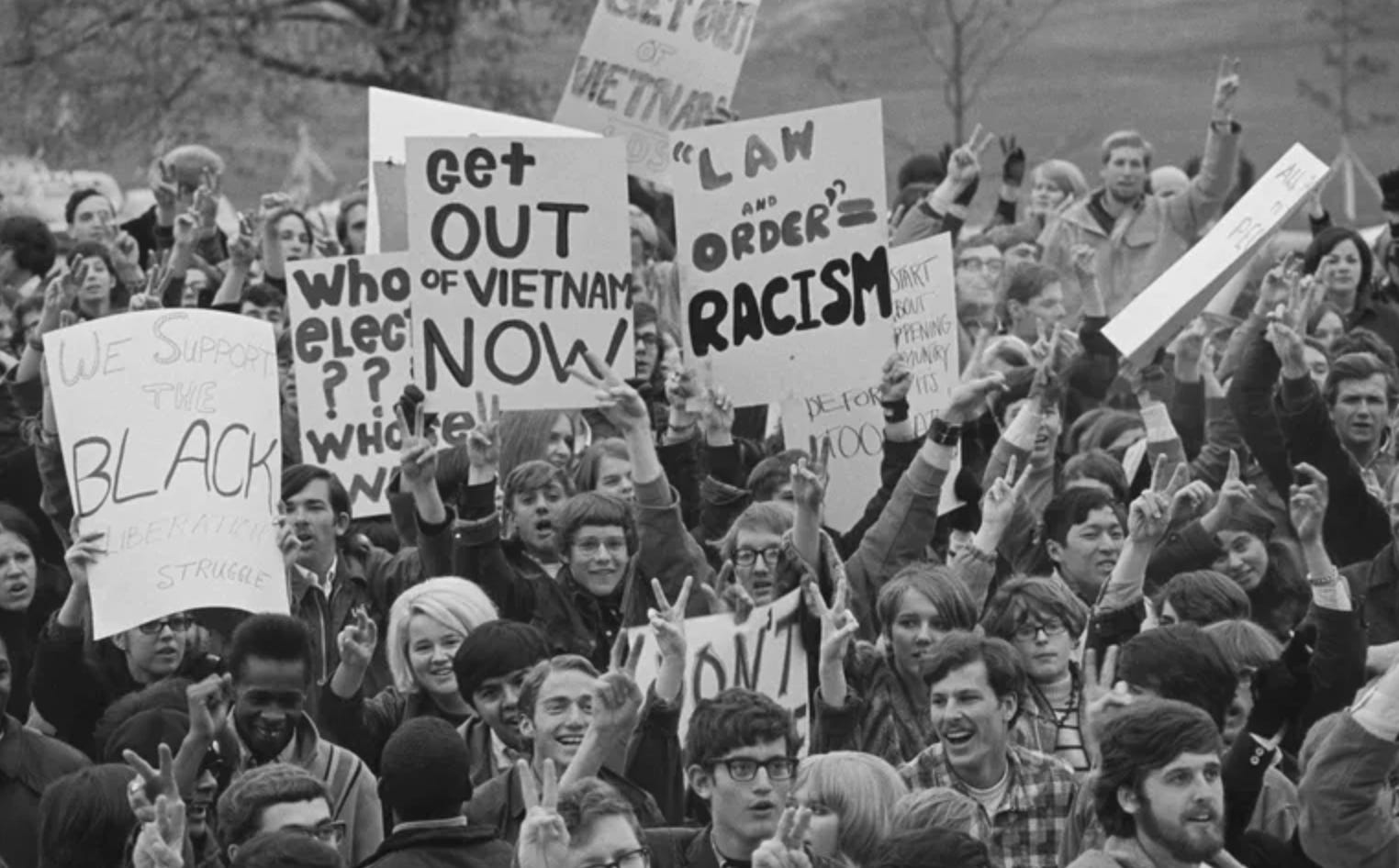
The middle class boom of the 1950’s, into the 1960’s, made the expansion of civil rights protections and the social identity movements aligned with them possible. Social class conflict was being successfully mediated among a large enough segment of the proletariat that bourgeois political parties were lifting restrictions on identity groups (granting “equal rights”).
The Powell Memorandum enshrined a strategy of bourgeois instrumentalism—the state would come to be commanded via a long-term plan of decreasing state social support programs and growing privatization. The corporate model (proportionate democracy for ownership, and their dictatorship over workers) was the ideal—the owning class would govern; the working class would have no say.
The transition away from a labor-elite, middle class whose income surpassed expenses to the degree they could invest, happened in the last decades of the 20th century. At the same time, the bourgeois—whose interests were directly represented by Republicans (and indirectly, by Democrats) launched the Reagan Drug War. Nixon had “brought the war home” with his 1970 declaration of a War on Drug Abuse, and the formulation of the Uniform Controlled Substances Act, which classified drug abuse as a crime by placing drugs with “no” medical value and “high” abuse-potential in the “Always Illegal” category. But Nixon’s was only a precursor.
The Reagan Drug War was a mono-partisan affair, in that the Corporate Party’s two franchises cooperated to create a state surveillance and discipline apparatus (“Drug-Free Zones,” National Guard flyovers, mandatory minimum drug crime sentences) in combination with corporations. Pre-employment and random on-the-job urinalysis became widespread, the “Just Say NO!” motto popped up everywhere, from grocery bags, to video games, to (unironically) kids’ candy made solely of refined sugar.
If we look at the privatization of discipline we see the drug offender caught by police and sentenced to a mandatory minimum sentence, would be laboring for two corporations at once (the ‘employment’ contractor, and the prison). Drug War policies were enforced most heavily upon the poor, the very same people who saw manufacturing jobs disappear from their cities. Capital development (and the geographic pockets of unemployment it produces) rendered the extraction of surplus-value impossible from this population, where they were. So policies were created to migrate them to where they could be used to produce value—at an even greater rate of exploitation than would be legally possible, outside the walls.
When the Project for the New American Century invented the War on Terror, they called for a massive, global update of surveillance technology. The Drug War’s surveillance relied on cops and urinalysis; the War on Terror’s went into computers and cell phones. We were informed many, many years ago that the United States government is capturing our “data” without warrants, but no Democrat did much to oppose it. In fact, warrantless state surveillance has only grown in scope and volume since Edward Snowden saw something and said something.
Back-to-back waves of increasing state control, and rising bourgeois instrumentalism did nothing to help mediate social class conflict, and workers’ earnings stagnated, while the economy grew. In actual effect, the more productive workers became as a social class the poorer they got. And there has been no substantive relief.
On April 1, 1990, the federal minimum wage rose to $3.80 per hour, for most workers. By July 21, 2009, it had grown to $7.25 per hour, not quite doubling over 19 years. On January 20, 2026, it is still $7.25 per hour, not increasing one cent, in 17 years. There is no current plan to increase the minimum wage, because it is also the maximum rate of exploitation. Increasing the amount that must be paid decreases individual profitability, and that, not promoting the general welfare, is the guiding principle of American society.
While working people felt the pains of their income shrinking, relative to economic growth, and the declining quality of life that accompanied it they sought relief. The candidates who promised change were the most appealing in 2016, but only one of them promised relief through persecuting others. They were—and have been—the wrong others, but the persecution feels good, even when it does nothing for them.
The War on Immigrants is our most recent foray into bourgeois instrumentalism of the state for the sake of the Class War. Just look at the policies—if one is bourgeois, one can buy entry to the U.S. and a fast-track to citizenship. Who is ICE pursuing? All of them are workers, many while they are on the job! Does ICE target employers, who are the demand side? Of course not. This is Class War.
Mass deportations are not creating employment opportunities for Americans (aside from ICE jobs), nor will they do anything to decrease the ongoing, mean rate of exploitation. Instead, the domestic surveillance apparatus is being enhanced (by DOGE) and turned on all workers. Various subsets are declared enemies (Liberals, Leftists, Trans, Protestors, etc.), placed on the margin, and are punished for being there.
The War on Immigrants is not a new thing—it is a continuation of a growing, fascist social order, imported from the corporate model, and solely to benefit the bourgeoisie.
Democrats, such as Senators Cory Booker and Elizabeth Warren, have made public statements in support of fixing ICE, while the general population favors abolishing it. Democrats are not an Opposition Party—they have shown over and over again that when it comes to building a surveillance state and disciplining working people, they are big fans and are glad to help. This has been happening for generations: From the Red Scare, to the Drug War, to the War on Terror, and now the War on Immigrants. Democrats show they favor fascism, too.
I suggest you use less Marxists terms so people reading don't put you in a certain basket and turn off from reading you multinational corporations would be better than the boregusis it's better if you want to reach a bigger audience not to use such value laden words remember the audience you are really after those with opposing views would turn off pretty quickly as preaching to the converted is the easiest path however not the best use of your time please don't take offence I agree with most of what you have written and this is only a fellow socialogist opinions I call myself a pragmatic idealist that rejects ideologies in any form they don't factor in unintended consequences or as Weber highlighted counter factuals all ideologies promise paradise if you conform to the script non has delivered on the promise and they all say someone might have to suffer before we get to the promised land I believe all we can achieve as a fallable species is a bit better place than we found it and if each generation strives to achieve this realistic task according to the principles of humanity and freedom as their templates the future will take care of itself. All I know is the more I know the more I know I don't know and that fills me with wonder.
Keep up the good fight however remember it's the other side you have to win over choose your words with delicacy and humility. Kindest regards Paul James Denman