
Valuing Education
Ignorance is expensive, so why cheapen our approach to treating it?

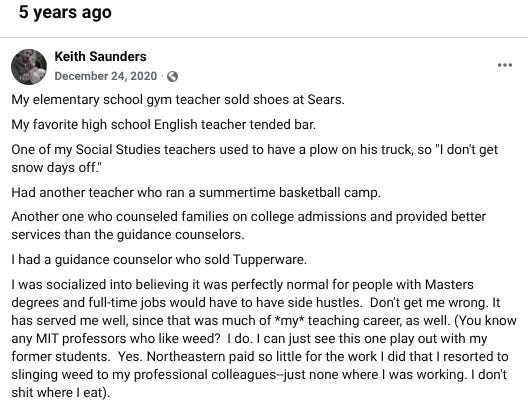
My elementary school gym teacher sold shoes at Sears.
My favorite high school English teacher tended bar.
One of my Social Studies teachers used to have a plow on his truck, so “I don’t get snow days off.”
Had another teacher who ran a summertime basketball camp.
Another one who counseled families on college admissions and provided better services than the guidance counselors.
I had a guidance counselor who sold Tupperware.
I was socialized into believing it was perfectly normal for people with Masters degrees and full-time jobs would have to have side hustles. Don’t get me wrong. It has served me well, since that was much of *my* teaching career, as well. (You know any MIT professors who like weed? I do. I can just see this one play out with my former students. Yes. Northeastern paid so little for the work I did that I resorted to slinging weed to my professional colleagues—just none where I was working. I don’t shit where I eat).
Adjunct instructors teach the majority of undergraduate courses offered at large universities, such as the University of Oklahoma. I have written elsewhere about how the relations of production in higher education has been wrangled into for-profit performance measures and practices, despite the non-commercial nature of learning as a social act.
There are all sorts of ways of knowing that will not produce profit; none of them are valued much in a capitalistic society. They are shunted off to “family” responsibilities, are relegated to “hobbies,” or are seen as a “waste of time.” Religious education, which far predates capitalism, is esteemed as valuable not for the profit it may directly produce, but from the hegemony (the consent to be ruled) it generates.

Scientific inquiry, on the other hand, has massive potential profitability. It has led to the development of full sectors of industry in synthetics, medicine, engineering, computers, and management. Scientific management distills education to resource allocation, and teaching is an expense. Students bring revenue to universities in the forms of tuition, fees, and grants; otherwise they are an expense.
While universities enjoy having one or two pop star faculty—a Carl Sagan or Noam Chomsky who gains a lot of media exposure—administrators do not want a roster of faculty that will themselves attract enrollments. They quickly become very expensive assets to hold.
Of all university expenses, the one easiest to manipulate are employee salaries—especially among non-unionized employees, as most faculty remain. While a tenure-track faculty member will typically be offered health care, matching 501(k) contributions, and teaching sabbaticals as part of their multi-year contract, adjunct faculty get a dollar amount per semester hour, no benefits, and the contracts expires at the end of the semester
Unless an instructor is hired for a full academic year (less than 10% are), their employment literally ends and begins again. Some schools will keep a record of ongoing “service time,” but it represents a series of discrete contracts, none of them lasting more than a few months.
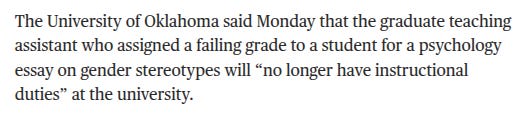
The University of Oklahoma said Monday that the graduate teaching assistant who assigned a failing grade to a student for a psychology essay on gender stereotypes will “no longer have instructional duties” at the university.
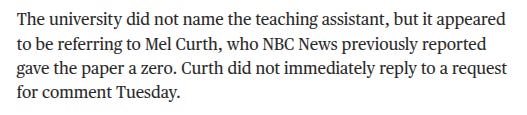
The university did not name the teaching assistant, but it appeared to be referring to Mel Curth, who NBC News previously reported gave the paper a zero. Curth did not immediately reply to a request for comment Tuesday.
She was not fired. This is a PR play by the University, to make it look like they are in compliance with Christian Nationalists’ demands. She was not offered another contract, is all.
The student protested her zero grade to the department chair, the chair had another instructor review the assignment, and they judged the grade to have been appropriately assigned. The student protested to the dean of the college. The dean realized the solution was to make it seem that something in particular was done, to shut the student up.
The instructor is a psychologist-in-training, the department chair is a psychologist, and the dean administers a school with a scientific psychology curriculum. Everyone involved knows a religious argument drawn from the Bible, is scientifically invalid. Absent validity, the assignment as submitted is without merit.
That’s just how science works.
The faculty member in question probably will not be re-hired by the University for as least as long as that student is on campus. And this speaks to labor relations as much as the scientific demand for empiricism. Because instructors are treated as service providers, rather than as intellectuals, both administrators and students have the impression that the educator “works for me.”
As I have explained to more than a few students—I do not work for you—I offer you advice and instruction in order for you to treat your deviance. You come to me ignorant, seeking knowledge and the means of discovery. I prescribe a curriculum and offer you treatments in the form of classroom time and assignments. If you engage in the required discipline, the curriculum will alleviate your ignorance.
You have agreed to be scaled by the standards of this institution and I will assign grades for assignments and the course, as I see fit (this is “academic freedom”). As you successfully engage in the university’s course of study, you will demonstrate rehabilitation and, should you have paid in full at the completion of your undergraduate coursework, you will receive a receipt that certifies you are no less-qualified than the least-qualified person to ever graduate from this institution of higher learning.
This student is trying really hard to be the least-qualified ever to be awarded an OU degree.