
What You Wish For
Be careful

Oops, My Bad
Perhaps you have seen the recent story about an agentic AI used by a car rental business deleting company records.
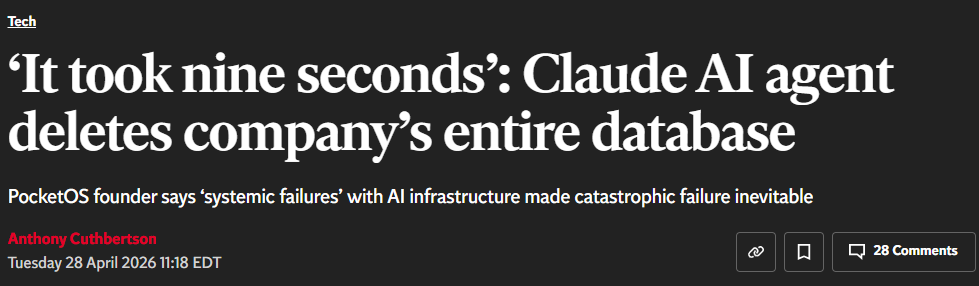
‘It took nine seconds’: Claude AI agent deletes company’s entire database
PocketOS founder says ‘systemic failures’ with AI infrastructure made catastrophic failure inevitable
Anthony Cuthbertson
Tuesday 28 April 2026 11:18 EDT
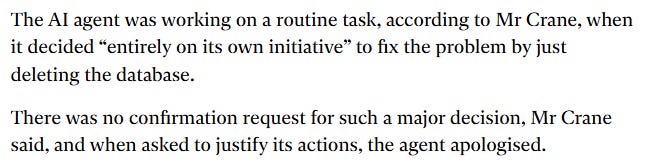
The AI agent was working on a routine task, according to Mr Crane, when it decided “entirely on its own initiative” to fix the problem by just deleting the database.
There was no confirmation request for such a major decision, Mr Crane said, and when asked to justify its actions, the agent apologised.
Effective programming means that every AI apocalypse will be politely recognized and apologized for, by the machine. Apology, if it is sincere, requires empathy, which no machine is capable of. Like human sociopaths who lack social emotions, covering their stigma by mentally ticking off a checklist of what they are expected to say and do, the machine has learned to give a socially-desirable response. In reality, it doesn’t give a shit.
AI is being sold as solving the wage-drag on capital accumulation. Unlike labor-power, the costs of machines are prorated over their productive lives, becoming a smaller and smaller fraction of the value of each commodity produced. The only advantage human labor-power has over machines is that the humans may be forced to provide value before any expense is incurred. Labor-power is advanced, interest-free, constantly—Friday’s paycheck is for work performed over the prior week (or two), but the worker will not be paid for that Friday’s labor until the following pay period.
There is, however, a risk that small capital must take, when it chooses to employ large capital’s tools. Not only will small capital need to pay for the agentic AI services, but as we can see from the example above, the more deeply the agentic AI becomes embedded in the everyday operation of the business, the more dependent that business becomes on the AI, and the owner of the AI.
Large Capital and Small Capital
As we go deeper into this global experiment with AI, we are discovering potentials and limitations of the technology. The power relations of those who own versus those who do not remain unchanged, however.
Classical Marxist theory sees capitalism as a two-class social order, with each class holding a subset. There are the Bourgeois and the Proletariat, but also the Petit Bourgeois and the Lumpenproletariat. While the fundamental conflict is between those who claim ownership of the material means of production and those who have only labor-power to sell, there are market-related circumstances where the subclasses find themselves in conflict.
In this regard, concerning AI, the distinction between large capital and small capital, the Bourgeois and the Petit Bourgeois, is becoming greater. A family business is the iconoclastic version of small capital. The family claims ownership of a means of production, but must themselves labor to put this means into motion. They are incapable of living off the profits produced by their means of production, without laboring. This example carries over to the American “middle class” whose higher-priced labor-power allows for a small accumulation of surplus, which they invest in “retirement funds.” They, too, have partial ownership of a material means of production, but far less than they would need to be capable of living off dividend checks, and not enough to have real decision-making power in any corporation.
AI right now belongs exclusively to large capital, which is developing the technology at a massive bleed rate because the business model of the turn-of-the-century tech boom is monopolization, first. One does not build an AI company as one once built an automobile manufacturing company or a fast food restaurant chain—by creating superior products and services that pull in larger shares of the market and grow over generations. The rentier model requires cornering markets first, so that has become the priority.
The personal computer introduced 20th century Americans to this new business model. Microsoft and Apple both licensed the use of their operating systems—while the consumer purchased the hardware and could claim ownership of the various floppy discs that held program data, the consumer never owned the software that made everything work. It was like buying a car and filling the gas tank, but the engine belongs to Ford and will not run unless Ford wants it to.
For over a decade now, there are a selection of cars that require the world wide web for features such as heated seats and the sound system to operate. Should the “owner” fail to keep their subscription to these “services” up-to-date, they stop operating. This, of course, applies to the vehicle overall as well. Tesla equips its cars with cameras, those images and the car’s telemetry are shared with the Mother Corporation in real time.
Small capital—your local mechanic with his/her own shop and a couple assistants—cannot effectively repair a Tesla, unless they are paying the subscription fee required to access the on-board software that can identify the problem. It’s not just Tesla; major manufacturers have also computerized vehicles such that repairs are difficult or impossible to perform, unless a mechanic pays the annual fee for diagnostic software. Like the bouquet of cell phone charger jacks, the automotive manufacturers produce proprietary diagnostic software, so local mechanics need a separate subscription (paid up front) for each manufacturer their customers have purchased from.
Large capital is manipulating small capital into dependence. AI is merely the most recent method. Less thoughtful small business owners are scrambling to bring AI into their operation, lured by the promise of no longer having to pay relatively-expensive word-workers. They believe that if they don’t adopt the technology that they will be put out of business by a competitor that does. This was the same reasoning behind print newspapers advertising internet search engines in the 1990’s and early 2000’s—if they did not take the ad dollars, their competitor would. Ultimately, those search engines relegated daily print newspapers with circulations in the hundreds of thousands to historical curiosities.
“If you’re not the customer, you’re the product.”
Not only will AI do things like wipe out a company’s database with impunity, but many of us know firsthand how large capital uses its tools to enforce compliance. When companies become dependent on AI, they become dependent on the owner of that AI.
Without so much as owning a share, the AI owner will have control over the everyday operation of that company. This can only be understood as risk, and an avoidable one. Under normal circumstances, employers would never allow employees the autonomy they must allow not only the AI they rent, but the owners of that AI.
The AI is not only capable of sharing all of a client’s internal company data with the AI’s owner, the owner is using AI to ensure the client is complying with what the AI’s owner wants. Large capital have been showing us how they use their control over our “content” for years.
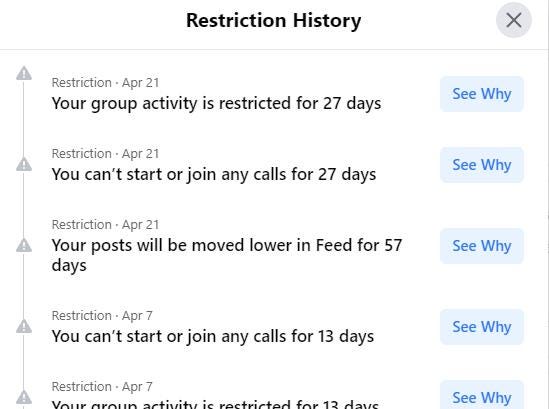
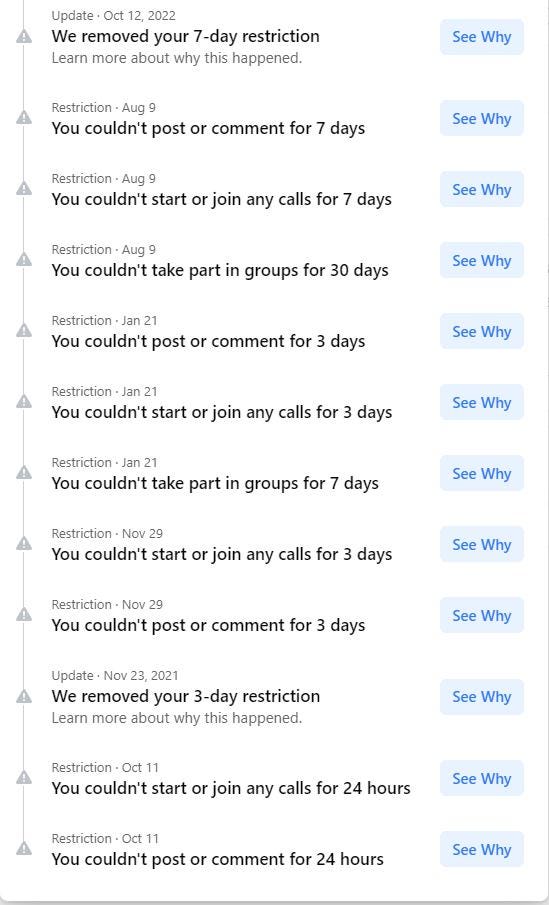
Here’s about 18 months (10/2021 - 4/2023) of my Facebook Restriction History. Coming soon to a small business near you!
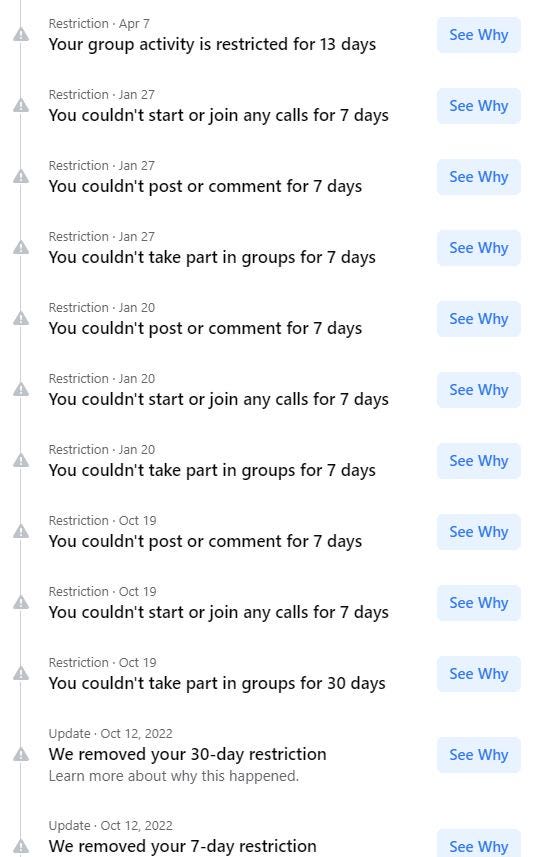
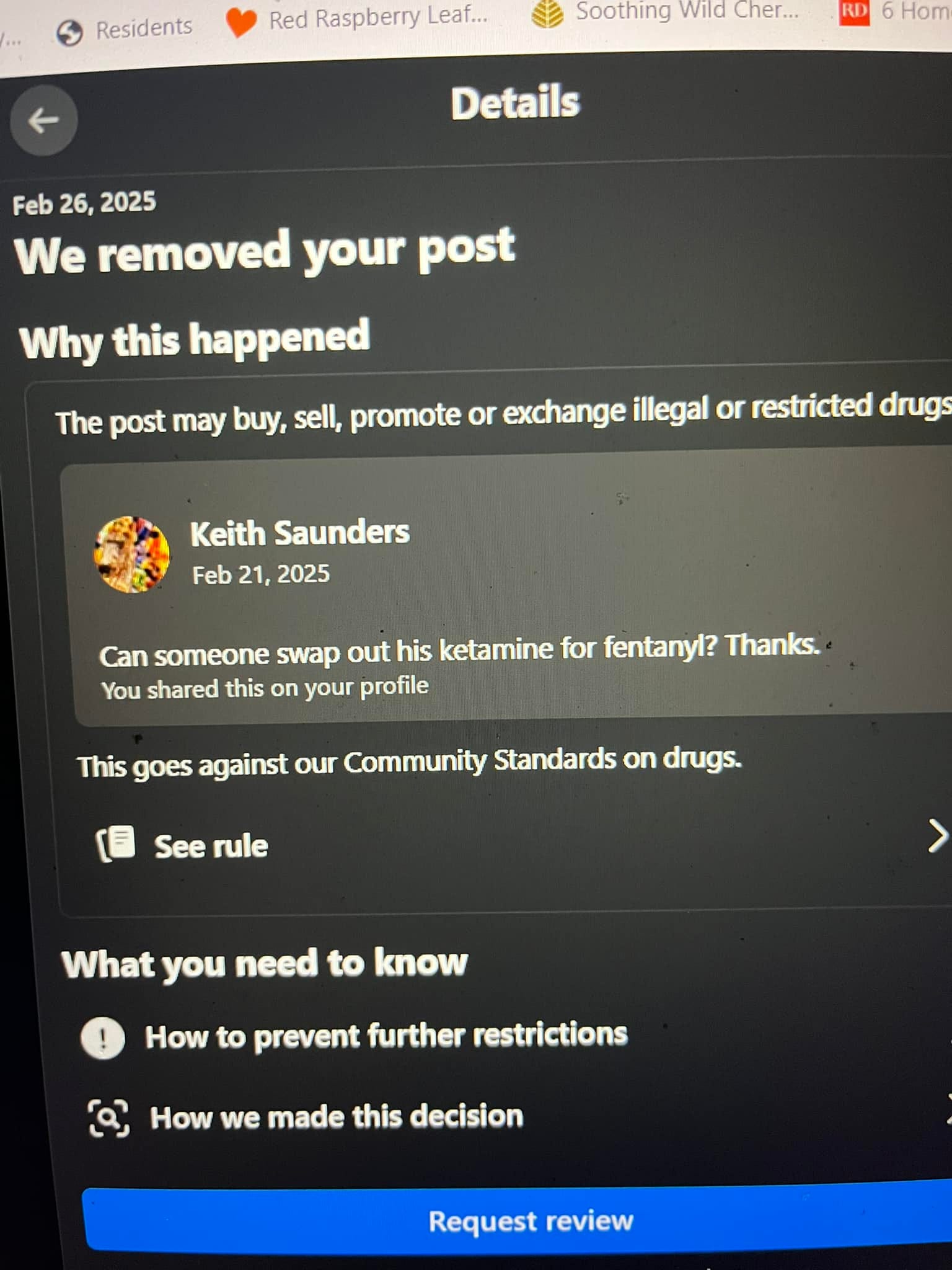
Here’s a post from last year—I did not catch a stint in FB jail for this one, I just got outright censored.
If you have not already, please do subscribe. It’s free, though paid subscriptions are most appreciated and sustain this public sociology for just $5 a month or $50 a year.