
Cannabigotry
Racism is at the root. Social caste-building is the goal.

Principles and Purposes

Today’s “Practicing Sociology Without a License” comes from “The Floral Society” page, which is a new project to move cannabis legalization forward by appealing to casual consumers in legal states.
Many marijuana reformers can trace the root of their activism to a particular encounter with police or other authority figures that did not turn out well for them. Having to overcome the cannabigotry and other obstacles to his undertaking drove Saunders, who had been in the “cannabis closet,” to become closer to his research subjects. To do research on marijuana reform activists, Saunders first had to become one, fighting institutional discrimination against a marijuana user—himself.
Twenty-six years later—The fight continues.
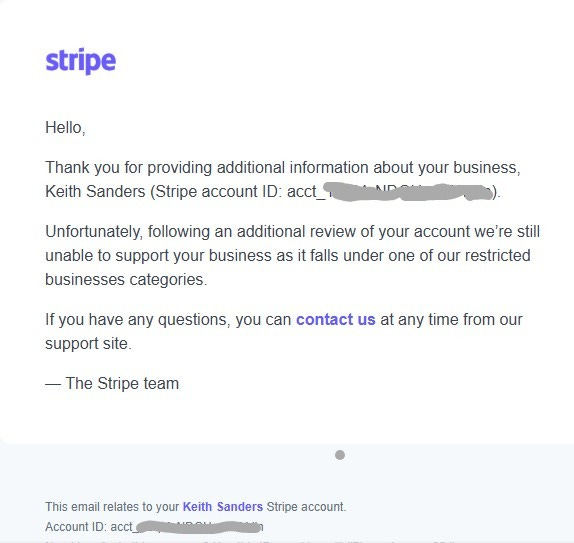
Hello,
Thank you for providing additional information about your business, Keith Sanders (Stripe account ID: acct_XXXXXXXXXXXX).
Unfortunately, following an additional review of your account we’re still unable to support your business as it falls under one of our restricted businesses categories.
If you have any questions, you can contact us at any time from our support site.
— The Stripe team
A couple months ago, I set up The Floral Society on Substack. While not the ideal platform for organizing a social club that seeks to bring people together in real life to share their knowledge and enjoyment of cannabis, I had hopes that it would prove less-censorious than the MetaGoog. It seemed to me that reporting not to be found on other platforms was being released on this one; I held out hope the subject matter of cannabis would not be a disqualifier. In general, it has not been for Practicing Sociology Without a License, where I have published photos, articles, and even quoted prices for cannabis flower, without any apparent shadow banning or outright deletion.
Facebook has not been nearly as understanding, as when I changed The Boston Pot Report page to The Floral Society. I was informed that my page would no longer “be recommended” because of the subject matter.
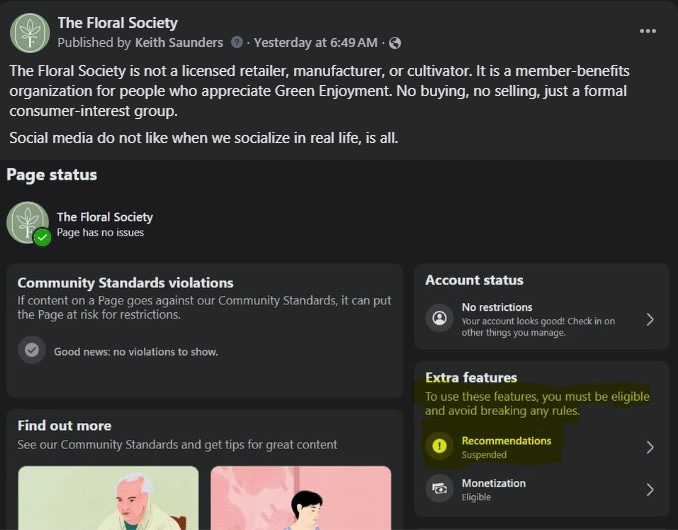
The Floral Society is not a licensed retailer, manufacturer, or cultivator. It is a member-benefits organization for people who appreciate Green Enjoyment. No buying, no selling, just a formal consumer-interest group.
Social media do not like when we socialize in real life, is all.
Going from a Facebook page for a radio show centered around cannabis news, politics, and culture, to a social club whose members share an appreciation for the cannabis plant, appears to have been a step too far.
Less than a week after launching The Floral Society on Substack, I was contacted by Stripe, the platform’s payment processor. The money-changers were concerned about me possibly sinning, and asked for clarification regarding the nature of my account. I repeated my assurance that The Floral Society does not engage in any form of cannabis sales; the point is to form social connections among the like-minded. Thoughts, not herbs.
I went through three appeals—still without anything resembling human contact (clients are not worthy of Stripe paying even prison-slave wages to handle customer support). My final appeal to get back into the good graces of this fully-automated, graceless machine (“The only product sold through The Floral Society is a blog subscription”) failed, as you can see above. Done in, not by Substack censorship, but by outsourced, payment processor, “Know Your Customer” censorship.
That is why I have not published anything new to The Floral Society in weeks.
Cannabis legalization does not translate into free speech (or commercial speech) about cannabis, on privately-held platforms. Creating a criminal marijuana prohibition required a lot of demonization, bigotry, and prejudice. All American drug prohibitions are launched by associating a drug with a particular, already-marginalized racial or ethnic group. Marihuana prohibition was facilitated by officials introducing the “Mexican” slang term to the American public. But American prohibitionists did more to spread knowledge of the psychoactive properties of the plant than the users themselves did.
Attaching a drug to an already-marginalized subset of the population is done to facilitate the demonization of the drug. To the extent legalization cannot move speech about the drug away from the margin, this shows a persistence of bigotry. What was once attached to the persons became attached to the drug, by portraying the drug as part of the user’s identity. Mexicans are believed to have negative characteristics, and the marihuana they smoke makes all of them worse. It grows into a chicken-and-egg proposition, that matters not where one starts. Mexicans are thought to be murderers and rapists (Trump was not the originator of these old prejudices) and they use marihuana, became marihuana causes murder and rape.
It is a matter of the racial minority luring the pure, innocent, white (female?) victim to their moral downfall. This was a theme of anti-marihuana propaganda in the early 1900’s; it ran through Harry Anslinger’s depictions of the “Marihuana Menace” decades later, and it underlies the “gateway hypothesis” introduced in the late 1960’s. The gateway hypothesis was an adjustment in prohibitionists’ discourse, forced by actual marijuana users no longer comporting with racial stereotyping. As the marijuana user became white and middle class, it was imperative that the (presumably) Black heroin dealer be brought back in. One puff of a marijuana joint leads to needles in the addicts’ arms.
The gateway hypothesis was a way of bringing racism back into drug policies, revamped to adjust to changing user profiles. The origins of the “opiate epidemic” of the past twenty years or so went largely unaddressed because our drug enforcers lacked a language for talking about when a white-owned drug manufacturer works to produce a white-dominated customer base, and addicts them.
This is the field in which Kevin Sabet and Project SAM operate today. How are we to deal with “Big Marijuana,” which poses unique threats, akin to other white-owned drug industries in tobacco and alcohol? The obvious line of attack would involve concerns about capitalism: exploitation, overproduction, manufacturing demand, monopolization, environmental impacts, worker and consumer safety, et cetera. But Sabet’s sponsors are capitalists, so he severely narrows his critique and instead blames stupid users, who can never be trusted to control their appetites. These few, bad corporate apples are seeking profit through (the otherwise morally-good) manufacturing and selling of commodities. It’s not the market, it’s the greedy people who are duping the otherwise innocent into buying and using drugs.
Marijuana Temperance, Social Class, and the ONDCP
The marijuana temperance campaigns of the drug war era are directed toward the class anxiety experienced by the middle class. To wit, the ONDCP’s print campaign from the turn of the 21st century employs a multitude of what Wagner identifies as “the tactics of de-contextualization.” What follows is a critical analysis of one advertisement, entitled “Bob Payne.”
“Bob Payne’s” daughter was led to using acid and mushrooms, “smoking ‘bud’ every day and tripping on the weekend.” Bob is white, middle aged, grayed, balding, and trenchantly suburban in an L.L. Bean-style oxford shirt, patterned sweater and all-weather coat, a grimace on his face. Bob is standing at the comer of a brick building with an arched doorway, in the middle distance is a bald male with a beard (a pimp, a john?), and at the left border of the photograph is a fire escape that bespeaks of an urban locale. Bob is at the borders of his element, the city long serving as his place of employment, or the site of his safe recreations, taking the family to the ball game or the symphony, or maybe to see an exhibit at the museum. But today Bob must walk the murky side of society, engulfed by the depraved sleazery of the flesh peddlers and pickpockets, for he is on a mission: he seeks his daughter, Lindsay (her school photo is at the lower left of the ad, place in slight overlap with the larger photo’s comer).
“How a marijuana habit forced Bob Payne onto the street,” reads the title of the ad. The eye is captured by a little lamb, bordered by the text of the ad; the stuffed animal belonging to an innocence forever lost, and what appears to be a pulled quote (although it’s not to be found in the text), in bold letters under the lamb’s feet: “’It was such a tough situation, because there was my little girl,’ says Bob, ‘She’ll always be my little girl, but she’s had to grow up a lot.”’ Underneath the bold text is the charcoaled end of an extinguished marijuana cigarette. The right side of the text also frames the image of a small metal pot pipe, tipped on its side, a pinch of marijuana placed next to it. A second “pulled” quote: “’One time I found a pipe, but of course she said it was not hers,’ says Sue, ‘I believed her.”’ According to the ad copy, Lindsay was supposed to be attending her marijuana abstinence self-help group, something that normally elicited little enthusiasm in the teen. Bob and Sue knew something was suspicious when Lindsay “seemed a little too eager to go to one of the meetings. So he decided to drive up there. Just to check.” It turns out that Lindsay has fallen prey to the worst natures of the dope fiend, lying to her family about her whereabouts in order to feed the insatiable need for more. Bob discovered her at a friend’s house. If this story is true (and I doubt it) Lindsay’s friend would live in the same suburban area she did, not in the back alleys of the city…
The textual message is “don’t trust your kids, especially if you’ve found them with marijuana before.” Lindsay had first entered the self-help group (all marijuana users need treatment) after talking with a former drug addict (marijuana is addictive) who spoke at her school (DARE and anti-drug programs are effective). The episode on the “street” was, in rehab terms, a relapse. “We refer to that day as ‘Dark Thursday,’ says Bob. Because that’s when Lindsay finally understood that her marijuana problem was out of control.” This last sentence is dripping with meaning, first and foremost, it is not a quote from Bob, although it is presented in a way that such a misunderstanding is possible. Second, it is counter to commonly held sentiment in the drug abuse/addiction recovery, 12-step organization, that the understanding that one needs help because one has a problem is fundamental to achieving sobriety. Third, it indicates that marijuana use is a problem in itself, somehow independent from all else in a person’s life. Fourth, it perpetuates the idea that drug users inevitably lose control and therefore constitute a threat to the society at large. (Saunders, 2002. Pp. 169 - 172).
The racial- and social class-coding of drug criminalization campaigns have become more subtle than they were in the first half of the twentieth century, but they persist. Two of the more popular “drug films” of the 1990’s were Requiem for a Dream and Traffic, taken by some as an indemnification of the criminal justice approach to producing abstinence. However, both films feature a white female in her late teens, trading her racial purity by having sex with a big Black man, in exchange for drugs.
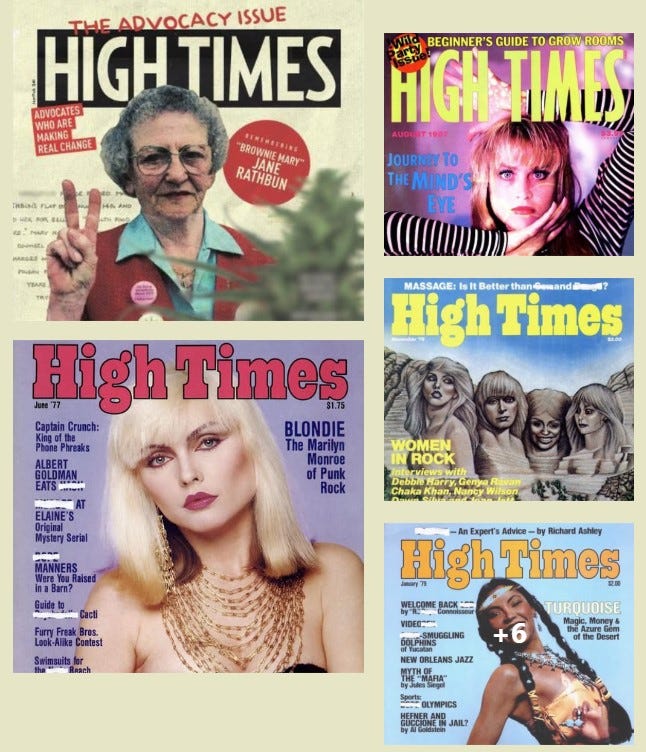
Cannabigotry is not new. It was the reason print editions of High Times were stocked behind the counter at the newsstand, with the porn. Today, as the brand has been revitalized and seeks social media reach, they are censoring themselves in anticipation of MetaGoog censorship that can result in being demonetized or blocked altogether.
Cannabigotry is not only a legacy of racist drug prohibitions, but internet platforms are utilizing it as a means of reinforcing status inequality among platform users. This particular form of censorship is part of the first wave of using social media to produce new social castes. The Untouchable have become the Unspeakable.