
Disadvantageous Positions
Breaking consumers and investors into smaller pieces serves only one social class's interests

The selfish individual who does not share was once considered the ideal consumer, as they were the smallest imaginable unit. Humans are hardwired to share, though, so commodities were designed so that they could not be shared. The Walkman, the “personal pizza” and other single-serving food portions, and the cell phone are a few examples from recent history of commodities redesigned to maximize demand by discouraging sharing.
Not content with reducing the consumer to a single body, Capital has promoted counter-consumption by the same individual, where “opposite” commodities/services are purchased to offset each others’ effects: Think convenience food and dietary “cleanses.”
For-Profit Food

If it seems we are living in a cartoon world with supervillains and heroes, it’s because we are creating narratives to live like them. Nietzsche’s “Ubermensch” is us, constantly becoming greater than we were before—everything’s accelerated, everything is magnified. Meanwhile we are divided into smaller and smaller consumer units because our ideal econom…
The liver, spleen, and kidneys are the body’s internal cleaning mechanisms, sufficient to remove impurities and lesser poisons for a lifetime. The belief that a particular collection of foods will “cleanse” the body (digestive tract, blood, lymph, etc.) is mechanistic reasoning. It relies on the belief that not only does our everyday food contain toxins, but that these toxins are more powerful than the body’s ongoing pursuit of homeostasis. That over time these microdoses of pesticides, herbicides, preservatives, and other chemical add-ons, will accumulate in one’s cells and organs.
The yoga instructor-prescribed treatment is to consume nothing but liquid—juiced, certified organic “superfoods,” apple cider vinegar, and alkaline water—for three days, every four months.
The source of the “problem” is market-based and collective—for-profit exchanges involve parties seeking to maximize personal returns. When it comes to food this means the producer is always seeking the minimum viable product—the least-costly (to them) form of what may be sold as “food”—and the highest practical price at sale.
For-Profit Food
If it seems we are living in a cartoon world with supervillains and heroes, it’s because we are creating narratives to live like them. Nietzsche’s “Ubermensch” is us, constantly becoming greater than we were before—everything’s accelerated, everything is magnified. Meanwhile we are divided into smaller and smaller consumer units because our ideal econom…
All those chemicals the consumer does not want, and that have become so hard to avoid, have been introduced precisely in the interests of the producer.
The solutions offered, of course, are individualized and will do nothing to alter the relations of production that have provoked large segments of the population to believe they are being poisoned by the food they eat. They are not encouraged to believe the problem comes from our relations of production—instead they rely on adjectives such as “greedy” or “big” that personalize or bureaucratize the reasons our food supply is nutritionally-weak and chemically-strong.
Along with individualizing consumption, Capital is seeking fresh contributions (“investment”) from smaller and smaller retail units. Mutual funds and other financial instruments have been created that allow small capital to join together as one purchasing unit to take advantage of the proportionally larger returns that come to large capital. One of the features of capitalism is that gain is not arithmetically proportional—those who hold more capital gain first and most, while smaller capital must face the pressure of that larger competitor holding a larger share of markets and operating at a greater economy of scale.
While the old financial markets moved their trading onto computers, there is an entire field of new capital markets that are computer-based. Among these are the multitude of gambling apps, blockchain apps, and phone-based futures markets.
Place Your Bets

I have been able to grind a month’s utilities payment out of a $100 stake with enough regularity to be comfortable with a built-in 2.1% player disadvantage at Blackjack.
The promotion below fell into my feed this morning. It is an opportunity to buy shares in a professional athlete’s career, with the hope of earning “from his future MLB income if he locks one down.”
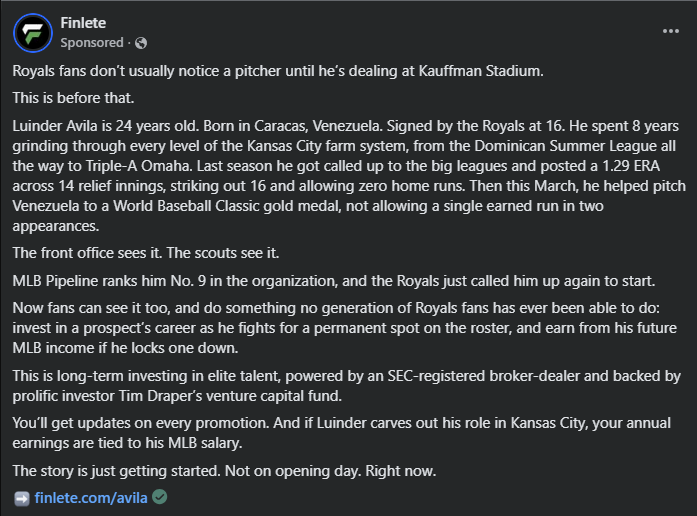
Royals fans don’t usually notice a pitcher until he’s dealing at Kauffman Stadium.
This is before that.
Luinder Avila is 24 years old. Born in Caracas, Venezuela. Signed by the Royals at 16. He spent 8 years grinding through every level of the Kansas City farm system, from the Dominican Summer League all the way to Triple-A Omaha. Last season he got called up to the big leagues and posted a 1.29 ERA across 14 relief innings, striking out 16 and allowing zero home runs. Then this March, he helped pitch Venezuela to a World Baseball Classic gold medal, not allowing a single earned run in two appearances.
The front office sees it. The scouts see it.
MLB Pipeline ranks him No. 9 in the organization, and the Royals just called him up again to start.
Now fans can see it too, and do something no generation of Royals fans has ever been able to do: invest in a prospect’s career as he fights for a permanent spot on the roster, and earn from his future MLB income if he locks one down.
This is long-term investing in elite talent, powered by an SEC-registered broker-dealer and backed by prolific investor Tim Draper’s venture capital fund.
You’ll get updates on every promotion. And if Luinder carves out his role in Kansas City, your annual earnings are tied to his MLB salary.
The story is just getting started. Not on opening day. Right now.
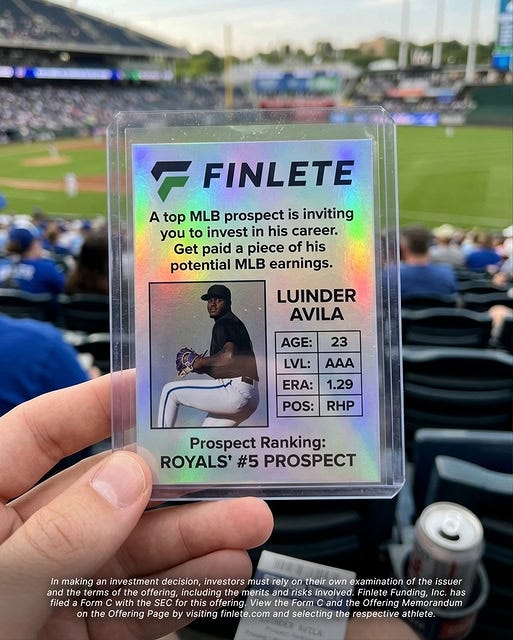
Should Avila pitch just 50 innings or be on the MLB roster for 45 total days (last season included) then he will qualify for the 2026 MLB minimum salary of $780,000. This begs the question—why is he seeking a cash infusion at this time?
Presumably, Avila will receive the money people are investing in his future salary, but considering the way celebrities have been used to endorse shaky or fake financial products (Tom Brady, Haley Welch) we have no guarantee Avila will receive a penny from the sale of these shares in his career.

Further, it is not clear if there is a cap on the amount that may be invested in the “Avila Fund.” While MLB players have the potential to make astronomical annual salaries, there is a limit to how much a player may earn in a year and over a career. Unlike other forms of capital, an MLB player’s labor-power has a terminal point where it will no longer be valued enough that he may find a buyer.
But that is where we are now. Instead of investing Capital itself, small, retail investors are being steered into investing in the most expensive labor-power. Yes, labor-power is capital, but by the relations of production, labor-power is proportionately the least-valued form of capital. It is a far better investment to buy an MLB team (up front cost for the least expensive team is ~$1.5B, according to Forbes) and then buy Avila’s and 24 other players’ labor-power.
Let’s say the Avila Fund raises $10M and Avila’s career earnings in MLB end up being $10M—Avila will have succeeded in raising his career salary in advance, but will (presumably) not get to keep any of it, and will fall short of being able to repay investors, since his salary will be taxed and agent fees deducted. Should Avila suffer a career-ending injury and not reach the hypothetical $10M mark, he will not be able to repay investors.
Only in the case where Avila’s earnings are close to 50% greater than his capital fund (35% to taxes, 10% to agent) will investors see the potential for positive return. But by the logic of capital, should Avila be paid $15M then he will return more than $15M in value to his employers, who will see their investment in his team grow faster than the public’s investment in his career.
If you have not already, please do subscribe. It’s free, though paid subscriptions are most appreciated and sustain this public sociology for just $5 a month or $50 a year.