
Going Mobile
Capturing society in motion

The More Things Change, The More Things Change
What constitutes the heart and boundary of a social movement? How are we to know social movements? What does a social movement look like?
One of the challenges of social research involves the immensity of the subject—it is not only impossible for any one person to experience the full range of human society, who that person is changes by their social location. The person experiencing and understanding a social group may only do so from their own subjectivity, which itself becomes altered through the experience and thus alters their understanding through the process of being among the group.
Society exists at all places where there are two or more people, and at all times when there are two or more people present. Further, society exists as discourse and dead labor, when there are less than two people present. Archaeology divines truths about social life through these things.

Historical narrative implies a consistency through time—that what once was has changed, however there is a marker of a sort that remains consistent and traceable. Britain sent exiles to the New World (after the Netherlands thought them too weird); they established Plimouth Colony in 1620 and 155 years later some of those living in Massachusetts and the other British colonies were not feeling so loyal to the Crown. They were in the process of establishing independence, which ultimately led to the creation of the United States.
The Pilgrims had no inclination toward liberal democracy, so why do we include them in the history of the United States? They were a religious sect, an ideological minority group that was considered dangerous enough to no longer be allowed to stay in Britain. What set them most apart from their native society—their faith—was neutralized by the secular state. Or at least there was an attempt to neutralize the power of religious belief in forming the social order here on Earth. Secularism was considered important enough to become the first clause of the First Amendment, in the second attempt at the first Modern nation-state.
Today, we focus more on the Pilgrims when considering American history than on the Articles of the Confederation, though the United States as it existed more closely resembled the spirit of the Articles than the Mayflower Compact.
With which repair does the original no longer exist? At what point do the modifications mark a differentness, such that there is no longer the original? These questions are moving toward the forefront, as we witness more and more actions taken without regard for the Constitution, domestic, or international law.
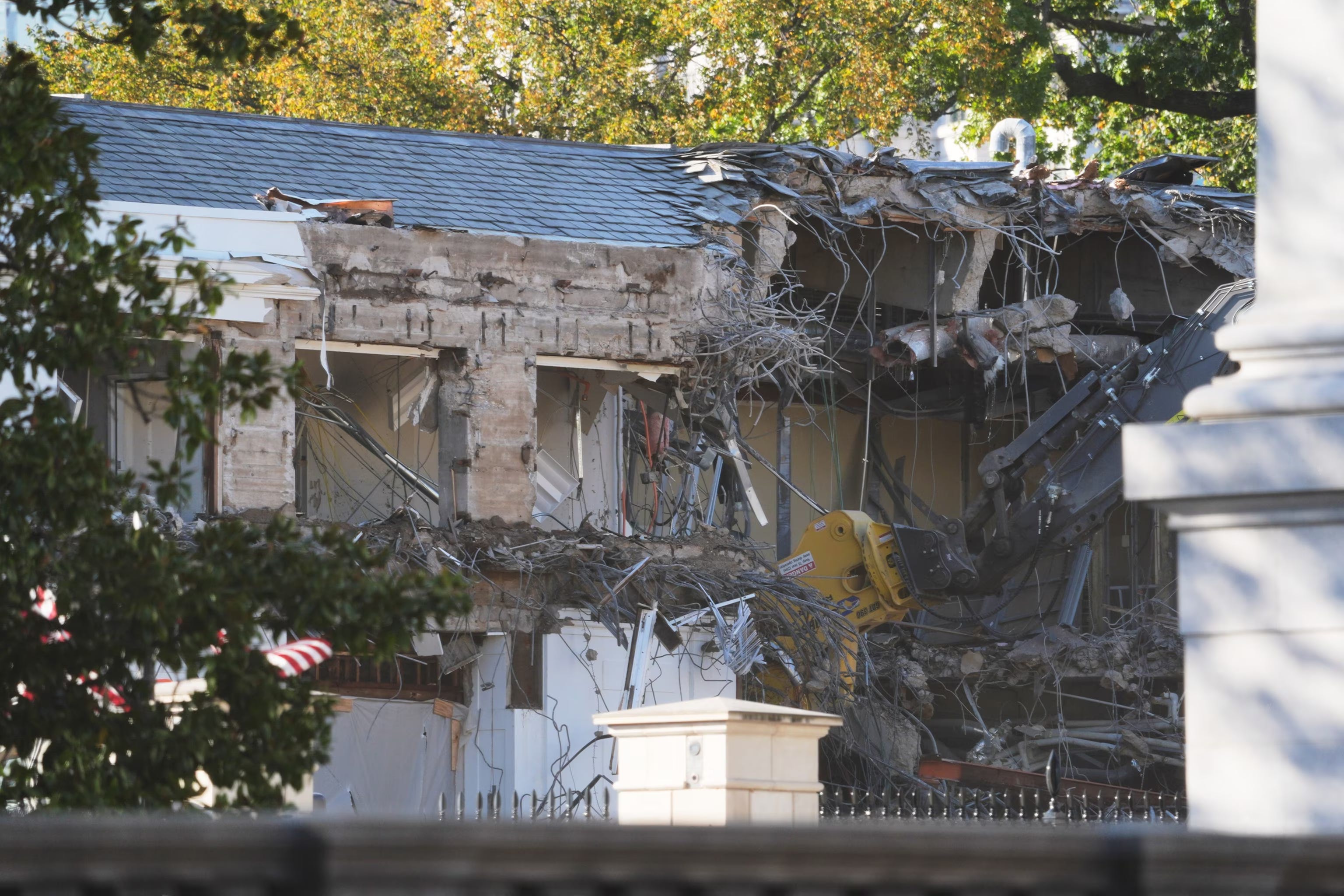
Despite the Executive being the Executive, federal buildings are under Congressional authority: Congress approves and budgets White House remodels. This was the main reason Trump sought private funding for his gaudy box. It also fits with the goal of further privatizing the state. However, demolishing a portion of the structure is most definitely against the law.
Destruction of Government Property - 18 U.S. Code § 1361
It is a federal crime to destroy or damage any property owned by or under the federal government’s control. This law is embodied in Title 18 U.S.C. 1361. Depending on the dollar value of the damaged property, if you’re convicted of this federal crime, you could face up to 10 years in prison.
Fortunately for Trump, his Supreme Joke says that since he can do no harm, he may commit no foul. We saw Bill Clinton impeached for less.
Speaking of, if special prosecutors are unconstitutional, does that mean we have to rescind Bill Clinton’s impeachment? Without Ken Starr’s dutiful pursuit of cum stains, we would never know that he lied about oral sex. Starr, of course, was appointed to examine Clinton’s involvement in a bad 1970’s Arkansas land deal. Even if the unconstitutional special prosecutor’s disqualification was a special “Trump-only” ruling, the Supreme Court has found that obstruction of justice cannot be committed by a President while engaged in Official Duties. Impeachment outside of office is literally impossible; whatever a President does in the role of President cannot be a crime, and without “high crime and misdemeanors,” a President may not be impeached.
Why do we still tell tales of Plimouth Colony? Why do we comport with some treaties, and not others? What forms of special exemptions to the law are tolerable while maintaining equal protection? How much, and what parts, of the constitution may be modified, before it is no longer the foundational document, or that the nation is no longer constitutionally-bound?
The document that was meant to protect the People from a tyrannical state has failed to do so. Returning to it, as if it would serve us to return to a past that failed to protect us, is a fool’s errand. We cannot rely on good faith and character to maintain order, because as we have seen, there will be those with bad faith and toxic countenance. Not just in the White House, but also throughout the electoral system.
The Trump Regime would not be possible without conspiracy among Republicans to forgo their Congressional duty to keep the Executive in check. Congress may never go into session again. They keep showing us they are actively committed to the coup. When the goal is to provoke civil unrest—as it has been from the outset of this presidency—what reason does a complicit Speaker have, to fund food and health care programs?
Let them eat nothing, and when they demand food, have the Boss call it “Insurrection.”
The only way out of this for you and me is to starve the Ruling Class of the means by which they rule. We cannot go back to the institution that allowed them to do this to us.