
Reparations
Injustice can be materially rectified

n.b.: In the time between drafting and finalizing this essay, the United States military has kidnapped Venezuelan President Maduro. My first though was to GHW Bush’s military kidnapping of Panamanian President Noriega for drug money laundering.
It turns out that Noriega’s arrest and imprisonment were not enough to end Panamanian money laundering, as close to two decades later we discovered the peninsular nation was laundering money for the global ruling class. Here’s a piece where I tied together the Panama Papers and the Jeffrey Epstein files:

Noriega was tried, convicted, and allowed to wear his military uniform while being held in an American federal prison, as the Geneva Convention allows officers to wear their uniforms while being held as a prisoner of war.
Yesterday’s piece was about social classes, and how the individual person who lays claim to vast amounts of capital become inconsequential, vis-à-vis their social class position. As everyone will die, I asked what might happen if the 150 wealthiest people were to find one of their New Year’s Eve guests had squirreled a small nuclear device onto one of the 153 mega yacht moored off St.-Barth’s, and all died at once. The short version: Nothing would change social class relations; their wealth would be distributed amongst their heirs, who would then become embodiments of capital. Their heirs, of course, are already of the bourgeoisie by virtue of mysticism and chance, but unlike some of their famous fathers and grandfathers, would not be recognized to have done anything in particular to have earned any claim.
How, then, would we go about dismantling a social class system that automatically defaults wealth freed by a claimant’s death to other members of the same social class? One way would be to outlaw obscene inheritances, for example, a $1 million cap per individual. People who like to think there are self-made millionaires should favor the reintroduction of freed wealth to be competed for in the market, as it will provoke new demonstrations of worth and merit, rather than hand it over to a person who did nothing to achieve it.
The problem with this approach, aside from objection by the wealthiest that they would not have “enough” heirs ($10billion is 10,000 $1millions), is that it will do nothing to address the relations of production that produce the larger economic stratification.
The answer lies in fairness. Those who had an excess of value extracted from their labors are due the imbalance. Reparations, in other words.
The first, gross objection always made to the proposition of reparations was recently captured by White Supremacist-cum-Orthodox Jew Ben Shapiro, who said flat-out, “They don’t work.”
When Charlamagne Tha God pointed out that Germany in 2025 still pays reparations for the Holocaust, Shapiro retorted, “That’s different.”
The suggestion that injustice could be materially rectified is indisputable to Shapiro, though to him American plantations, unlike German concentration camps, were not an injustice.
The slightly more nuanced argument notes that U.S. slavery ended 160 years ago, and the passage of time and layers of migration since then have blurred the distinction of exactly who might owe exactly what, to exactly whom.
Reparations for chattel slavery is a complex task that we are sure to screw up, and that would mean racial minorities (African-Americans, especially) might unfairly benefit, and if we have learned anything from the Trump Administration when it comes to race, is that racial discrimination is wrong, especially when it might look like it is happening to white people.
The argument itself has as much merit as the People of the United States throwing in the towel for real Congressional representation because our building is too small.
To return to 50,000-constituent Congressional districting means increasing the size of Congress to 6,700 members.
But how would they ever meet? Online, mostly. We would no longer have use for the Capitol building, which has for years been used to constrain our democracy by physically limiting the size of the assembled body. Sorry, American democracy failed because our building was too small! Is that any way for an Empire to go out?

What might it look like if we were to pursue reparations for wage-slavery, instead?
Unlike chattel slavery, wage-slavery has been carefully documented, ever since we unofficially made Social Security mandatory. We have all the records. We can see who has paid what for Social Security taxes and extrapolate to their income earned through selling labor-power.
What’s that? The folks who earned above the cap won’t get credit for what they earned above it? The point of reparations is to repair injustices, such as exempting the highest incomes from taxation and what that has led to.
Actually, nationalizing capital is not even that difficult. The Trump Administration has been doing it to various industries, in this second term.
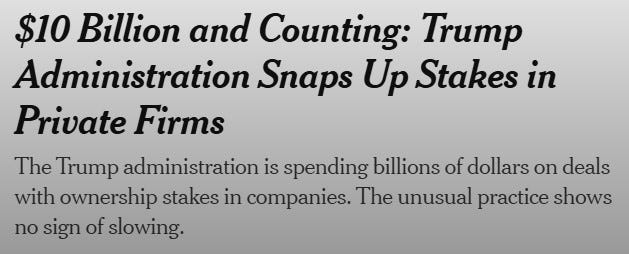
$10 Billion and Counting: Trump Administration Snaps Up Stakes in Private Firms
The Trump administration is spending billions of dollars on deals with ownership stakes in companies. The unusual practice shows no sign of slowing.
Partial nationalization of corporations is part of a larger plan. When the nation-state itself collapses, those holdings have to go SOMEWHERE. Trump has taken the 1971 Powell Memorandum’s direction to break down state supports to its greatest extreme, thus far, with the DOGE attack. Powell would have objected to any form of nationalization, but Trump understands state-held wealth will be up for grabs, a la the collapse of the Soviet Union that resulted in Vladimir Putin becoming the actual wealthiest man in the world.
Reparations for wage-slavery would look a lot like repatriating foreign-held assets, liquid assets especially, the nationalization of infrastructure and social services, national health care, tuition-free education, public media, and national governance with hyper-local representation (see “Cleaning Elections” above).

Reparations for wage-slavery would take the form of the People claiming ownership of the nation and its resources, in the sense that no minority class of people would be able to dictate the production or distribution of the majority of value. The Dictatorship of the Bourgeoisie would be replaced by a Dictatorship of the Proletariat.