
Why the States?
The prohibitionists' strategy offers clues to where we are with weed in America

There are prohibition-by-popular-vote efforts underway in Massachusetts and Arizona (Maine’s campaign failed to get enough signatures to qualify for 2026 ballots). To my knowledge, these mark the very first attempts to deregulate and recriminalize marijuana, by the ballot.
Criminal drug prohibition has public support, of course. But as a social policy in the United States, it is barely 100 years old. The 1924 Anti-Heroin Act was the first federal law to criminalize a substance itself.
The 1906 Pure Food & Drug Act, the first federal drug law, required true labeling; it was a consumer protection law.
The 1914 Harrison Act taxed “narcotics” (cannabis was specifically excluded); those found in violation of the law were charged with tax evasion.
The 1919 Volstead Act prohibited commerce in drinking alcohol. The substance itself was legal, and was still used in medicaments (one could be prescribed “medicinal alcohol”) and in religious liturgies.
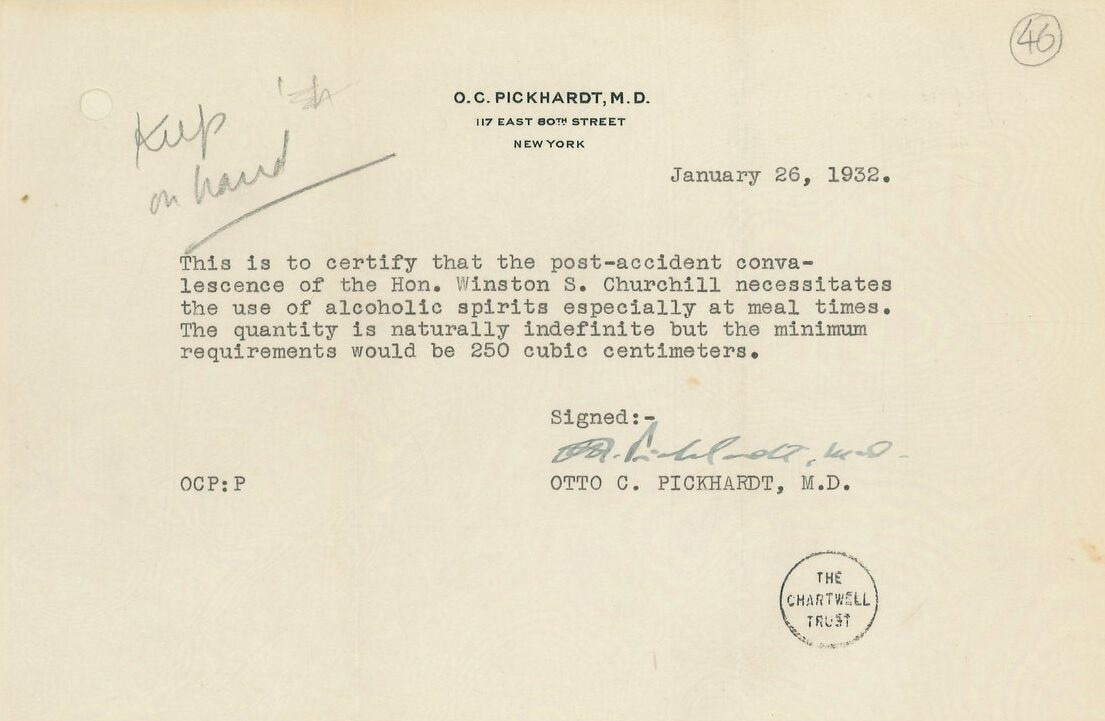
January 26, 1932.
This is to certify that the post-accident convalescence of the Hon. Winston S. Churchill necessitates the use of alcoholic spirits especially at meal times. The quantity is naturally indefinite but the minimum requirements would be 250 cubic centimeters.
Signed:-
OTTO C. PICKHARDT, M.D.
The 1937 Marihuana Tax Act, too, did not criminalize the substance outright, but instead levied a prohibitive tax, an amount so high ($100 an ounce) it made legal commerce impractical.

The 1970 Uniform Controlled Substances Act was a politicized effort to place “all” drugs (exceptions were carved out for the most popular non-medicinal drugs: tobacco, alcohol, and caffeine) under a single regulatory scheme, based on “medicinal value” and creating a category of drugs deemed to have no medicinal value and a potential to be abused, and making these substances themselves then the source of criminality. The law’s concern with “abuse potential” is superfluous for Schedule I, since the only quality needed to assign a drug to that Schedule is to deny it has any medicinal value at all. The DEA’s (also created by the CSA) position on cannabis, by law, is that it has no medicinal value.
A critical eye shows the first drugs that were prohibited by Congress under the CSA had been rising in popularity among younger people, in the decade prior: marijuana and hallucinogens, in particular. There was a nascent marijuana policy reform movement, that had already gone through three, growing phases of resource mobilization. Organizers were localized in the first two phases—LeMar and Amorphia—but NORML had eyes on changing federal law, as well.
Fast-forward 18 years and DEA Administrative Law Judge Francis L. Young ruled in NORML’s favor (in one of the longest civil actions in U.S. history), recognizing the medicinal value of the plant, and thus necessitating its removal from Schedule I (no medicinal value). Findings in administrative law do not apply to the Administrators themselves, though, and each successive head of the DEA has ignored Judge Young’s ruling, as the law requires them to.
Yes, the 1970 CSA locked prohibited drugs up tight. It’s among the reasons we need to rid ourselves of this drug policy, that defaults to criminalizing “drug abuse” it never defines.
The Nixon War on Drug Abuse focused on recasting federal authority over drugs. The Reagan War on Drugs, expanded surveillance, brought large corporations into either financial (private prisons) or communications (Partnership for a Drug-Free America) partnership with the federal government’s mission to “eliminate” illegal drug use. A national genocide of the cannabis plant was an expressed federal policy with considerable resources dedicated to “eradication”: finding, killing, and burning feral hemp.
The federal emphasis on criminalizing drugs and those who would be in proximity to them spilled into the states, which also began creating drug-specific reasons for increased surveillance (“Drug-free Zones”) and penalties (mandatory minimum sentences, especially). For reformers, it was a decade (1984 - 1994) of lost gains, stigmatization, and declining marijuana use rates (due to birth cohort density, more than policy), despite Judge Young’s 1988 ruling.
Coming out of the Reagan Drug War (which became the Bush, and then the Clinton Drug War) the remaining national level marijuana reform activists decided the only practical means of shaping federal policy would be to end state prohibitions. Eventually, the reasoning went, enough of Congress would represent states with legalization so that they would have to change federal law.
California voters passed Prop 215, leading to medicinal marijuana in that state and a handful of others, before 2008, when Massachusetts voters became the first to decriminalize marijuana by voter initiative. In 2012, both Colorado and Washington voters ended their state’s prohibitions and would soon develop regulatory schemes and begin collecting taxes.
Obama’s Department of Justice issued two memoranda that outlined conditions for a “hands-off” federal approach to states with medicinal and legal markets. Congress defunded DEA raids of state-legal medicinal grows. This approach ended the turmoil caused by the federal government violently enforcing a policy the people of a given state had rejected.
The real boom in medicinal marijuana and legalization came after the 2016 elections. In the six years that followed, many of the former total prohibition states began allowing plant-derived CBD and THC as medicine, while an additional 16 states legalized “adult use,” with most all of them establishing retail markets.
And that is why today’s re-prohibitionists are taking their cases to the states. Just as NORML and other reform groups discovered: when federal policy is not going your way, you cannot expect to directly change it; you will have much more success at the state level.
The striking difference, however, is that prohibitions have never come from the popular vote itself. Why would people want to invite state intrusion into their lives, eliminate a multi-billion dollar industry (and the $30million a month in Massachusetts tax and other revenues it spurs), criminalize themselves and their neighbors, and otherwise return to a policy the voters clearly do not want (they passed decrim in 2008, medicinal in 2012, and legalized in 2016—each on the very first try!)?
The deceptive practices used by signature-gatherers hired by the recriminalization campaign were first identified by Chris Faraone in Talking Joints Memo months ago. Without signature-gatherers lying to people about what they were signing, there is much less chance they could have collected enough signatures to qualify for the ballot.
What good does it do a campaign to lie, to qualify for the ballot, when their question is fundamentally unpopular? First, it makes the organizer look like he’s achieving something, that his pitch to funders for his ongoing salary was legitimate. It is to fundamentally to deceive benefactors through Election Day, when the truth comes out (it won’t get 40% support). Second, it presents an illusion through commercial media that such an initiative is as good as any other initiative, like the one to end prohibition, in 2016. The ensuing coverage is milked for its ability to legitimize recriminalization itself—a ballot question is a news story, and all ballot questions are equally legitimate. Therefore recriminalization has significant public support, just like legalization did.
See how that works?
But before one can achieve a majority of public support, one has to manufacture the cultural change needed for that support to exist. The recriminalizers will do this via their now-legitimate media exposure of their messaging. It will consist of risks and threats, and frame recriminalization as a commonsense response.
Keep in mind all the risks and threats they promised would come with legalization. Think about how many of them that did not come true. Then think of how many of their promises of social decay (unemployment, increased crime, increased youth use, falling real estate values) turned out to be exactly the opposite of what happened.
They are just as full of shit, today, and Kevin Sabet’s got his benefactor eating it up. Dude, you don’t put a guy who’s run a 2 - 22 record since 2016 in charge of your multimillion-dollar campaign and expect to win.